Search This Blog

3/01/2013

Soil Blocks...Let the Gardening Begin

Although the outside weather merely hints at the milder days ahead, indoor conditions are ideal to begin planting. The long winter wait has come to an end and I can finally rub soil between my fingers again. It's time to plant the first seeds of the season.
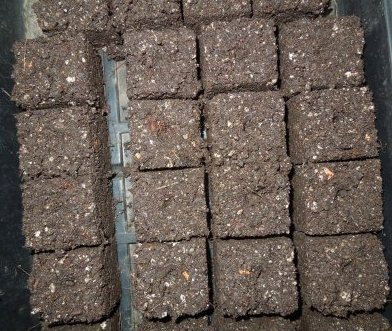
Soil blocks are a great medium for starting seeds under grow lights in the basement.  When transplanted into the outdoor garden, tender new roots do not have to struggle past barriers (as with compost-able pots or pellet netting), or become damaged (when removed from plastic pots).

 Eliot Coleman suggests this soil block starter mix in The New Organic Grower: 
3 (10 quart) buckets of coco peat
2 buckets of perlite 
1 bucket of garden soil 
2 buckets of compost 
1 cup each of blood meal 
1 cup of colloidal phosphate
1 cup of greensand 
½ cup of lime
Mix thoroughly.

* I substitute coco peat for peat moss as a sustainable option.

By shaking the soil and compost through a screen, large clumps, rocks, sticks, and pits are removed. 


The large pieces would inhibit a young seedling's ability to emerge from the soil.

Screened ingredients should be thoroughly mixed with a shovel. A wheel barrel makes an effective "mixing bowl".

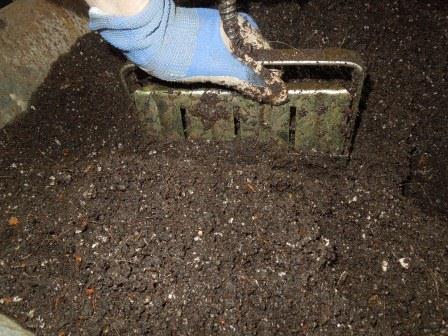
Moistening the mix makes pressing the soil into compressed cubes easier.
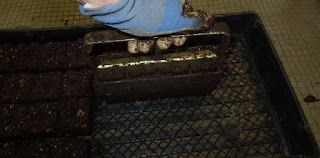
The soil block's spring mechanism releases the "pot-less" containers.
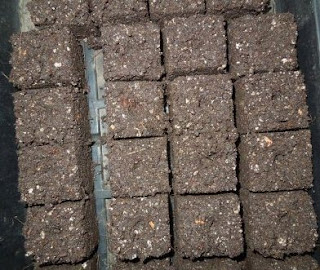
A small indentation on the top of each block awaits its seed.
Watching seedlings emerge from the blocks is the closest I can currently get to gardening while I wait for the snow to melt away, and the soil dry out--to become "workable".

2/17/2013

Making Maple Syrup - Boil & Bottle

Today was boiling day (perhaps not the best choice with temps in the 20's).  
I spent the day adding wood to the fire and sap to the pot.
I maintained one open pot at a rolling boil and in a separate feeding pot, I heated the cold sap from the storage buckets.
Maggie kept me company.
The sap boiled down...slowly....
Once the sap was close to the correct temperature (boiling temperature plus 7 degrees--in Pawling 219 degrees), the final boiling was done inside where the heat was easier to control.
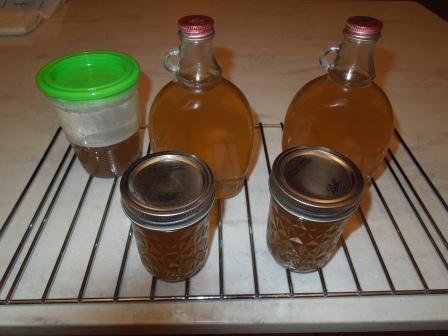
Eight layers of cheesecloth filter out solid particles. 
Boiling water sterilized the jars and bottles.
The taste?
Worth the effort!
Previous posts on Making Maple Syrup:


2/16/2013

Making Maple Syrup - Day 5

Sap nearly fills the bucket daily.


Thanks to my local deli and pizzeria, large food grade buckets help me collect and store sap.

Taking advantage of Nemo's bounty, the sap filled buckets are snow packed to keep them cold on warm days, until the sap can be boiled into syrup.   


Previous maple syrup post: Tap Tap Tap - Making Maple Syrup 

2/12/2013

Tap Tap Tap - Making Maple Syrup

A friend of mine gave me a maple syrup starter kit as a gift over the holidays. Since receiving the kit, I read about the process, watched YouTube videos, and impatiently waited for the weather forecasts to predict daytime temps in the forties and nighttime temps in the twenties for an extended period. These conditions finally arrived this week, so I trekked out through the snow to insert my shiny metal spouts into three maples surrounding my house. The buckets now hang, collecting sap. I listen contentedly to the continuous dripping of the watery liquid.  
Mark the bit with a tape guide and drill a hole 2" into the trunk, 3' off the ground.
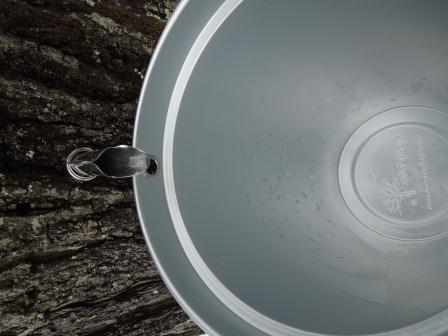
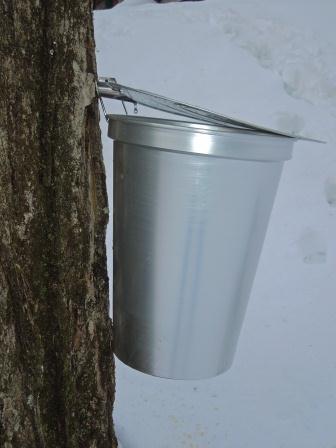
  Tap, tap, tap, the spout into the hole with a hammer and attach the bucket, capturing the flow.
The sap immediately begins to drip, as if  waiting to be released: "Tap, tap, tap." 
The cover protects the sap from foreign debris.
Our climbing tree now offers spring greenery, a summer perch, brilliant autumn color,
and sweet winter sap.  What more could we ask from our tree?


Tomorrow, I’ll set up an outdoor fire pit to boil the watery sap down into syrup; it will take at least forty gallons to produce one gallon of maple syrup. I'll keep you posted.

Resources   
Cornell Publication:   Maple Syrup Production for the Beginner


Maple Syrup Made Simple - Home Made Syrup

12/30/2012

Recycling, Does it Really Make a Difference?


     Plastic packages in all shapes and sizes now display the ubiquitous recycling mark. But when so much energy is used to collect, clean, and re-manufacture products from recycled materials, does it make sense to go through the hassle of recycling?  Does it really make a difference?
    Acknowledging that it's best to limit packaging and unnecessary purchases, and reuse whenever possible, once the package or container is no longer useful, is recycling is the most environmentally sound option?  The answer begins with energy consumption, but goes well beyond.


     The amount of energy needed to extract raw materials is, in fact, greater than the amount required to collect and process the recycled material for reuse in manufacturing.  Popular Mechanics reports that on average it takes “10.4 million Btu to manufacture products from a ton of recyclables, compared to 23.3 million Btu for virgin materials; collecting, hauling and processing of those recyclables adds just 0.9 million Btu.”1 That is significant energy savings.

The difference in energy use when comparing processing recycled, rather than "virgin" materials, varies a great deal from product to product:
 (videos describing each process are included)

Recycling an aluminum can uses only five percent of the energy needed to make a can from bauxite ore, the natural source of aluminum.

Newsprint, the paper used in newspapers, can be recycled into new newsprint using only 55 percent of the energy needed to make it from wood and other raw materials.


Recycling glass into new products uses 80 percent of the energy required to make new glass. While this is a smaller energy savings than some other materials, it still adds up when the huge amount of glass used worldwide is considered.


Many plastic water and drink bottles are made from PET (polyethylene terephthalate) plastic. While it can be difficult to recycle these into new bottles, PET can be recycled into other plastic products using roughly 33 percent of the energy needed to make plastic from scratch.2 


 Recycling does far more for our environment, however, that save energy.
  • Recycling avoids wasting valuable materials (a recent study that found that about 90 percent of the material going to landfills has a market value3).
  • Using recycled material in manufacturing creates less air and water pollution than using unprocessed, virgin raw materials.4
  • Compared to incinerating, recycling significantly reduces the amount of COin the atmosphere.5
  • Recycling saves natural resources: trees, ores, sand, and petroleum.
  • Recycling makes it unnecessary to deface the land by logging and mining.
  • Recycling avoids utilizing land for landfill.
  • Recycling creates jobs.  The US Bureau of Labor lists a variety of jobs related to recycling: driverssortersmechanics, technicians, and machinery maintenance workersmaterial recovery facility managersroute managers, and sales representatives6

Recycling reduces the need to extract, process, refine, and transport timber, crude petroleum, and ores. It lessens the toxic air emissions, effluents and solid wastes that these manufacturing processes create.4  

     So when you find the familiar triangular arrows on packaging, know that it is worth the effort to recycle.


12/02/2012

Purchase Power


To view a larger, more readable version, of this chart go to Cornucopia.org;
 click on the chart to enlarge.
       Money is power--politically speaking--and when I make purchases, I am channeling my money to companies that can then use that money in the political arena.  When I spend money on a product, I support the company that sells that product.  When I withhold spending on  a specific product, I withhold my support for not only the product or label, but the larger company, as well.
     Cornucopia's chart shows the amount of money different companies spent to support or oppose Prop 37, which would have require labeling of GMO’s.  Since I support GMO labeling, a concrete action I can take is to purchase organic products from companies that support my “right-to-know”.   It's a simple, effective way to make a personal statement.
     I can't compete with the millions of dollars spent to fight the labeling legislation, but I can funnel my family's grocery money to companies that support the causes we value.


11/25/2012

Yoga, Sustaining Body and Mind

     While standing on one foot in a contorted yoga balancing pose…for what seemed like an eternity…I thought, “Yoga deserves space on this blog, because it sustains me, body and mind”.  It helps me feel refreshed, strong, flexible, balanced, and focused, while adding very little to my ecological footprint--especially when done at home or at a location that's close enough to ride my bike.
     One of the best aspects of yoga is that there are few, if any, supplies needed.  A mat is useful, but a carpet works just as well.  Comfortable clothes and some relaxing music are helpful.  Poses can be done indoors, outdoors, in small rooms with a few people, in large studios, or in any room where the furniture is simply moved aside.
     Yoga is one of those life-long exercises that is practiced everywhere along the age continuum.  It can be adapted to meet most people’s needs, even well after many other exercises are no longer possible.  There is rigorous yoga, regenerative yoga, and even chair yoga.  It relieves stress and anxiety, increases range of motion, builds bone density, strengthens muscles, increases flexibility, and improves balance--to help prevent falls.
   
Local yoga classes that fit a variety of schedules and budgets:

Ensure a minimal footprint by purchasing "eco-responsible" mats and recycling your old mats at RYM.


     Yoga keeps me on my "tiptoes" physically, mentally, and ecologically.