A friend of mine gave me a maple syrup starter kit as a gift over the holidays. Since receiving the kit, I read about the process, watched YouTube videos, and impatiently waited for the weather forecasts to predict daytime temps in the forties and nighttime
temps in the twenties for an extended period. These conditions finally
arrived this week, so I trekked out through the snow to insert my shiny metal spouts into
three maples surrounding my house. The
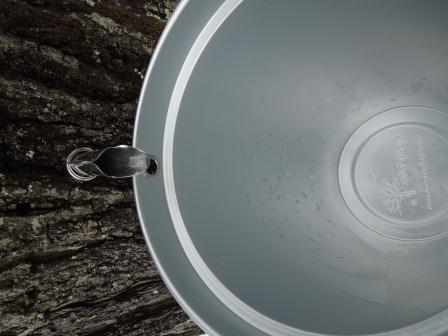
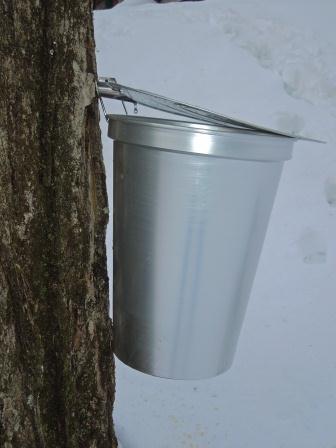
buckets now hang, collecting sap. I listen contentedly to the continuous dripping of the watery liquid.
Mark the bit with a tape guide and drill a hole 2" into the trunk, 3' off the ground.
Tap, tap, tap, the spout into the hole with a hammer and attach the bucket, capturing the flow.
The sap immediately begins to drip, as if waiting to be released: "Tap, tap, tap."
The cover protects the sap from foreign debris.
Our climbing tree now offers spring greenery, a summer perch, brilliant autumn color,
and sweet winter sap. What more could we ask from our tree?
Tomorrow, I’ll set up an outdoor fire pit to boil the watery sap down into syrup; it will take at least forty gallons to produce one gallon of maple syrup. I'll keep you posted.
Plastic packages in all shapes and sizes now display the ubiquitous recycling mark. But when so much energy is used to collect, clean, and re-manufacture products from recycled materials, does it make sense to go through the hassle of recycling? Does it really make a difference?
Acknowledging that it's best to limit
packaging and unnecessary purchases, and reuse whenever possible, once the package or container is no longer useful, is recycling is the most environmentally sound option? The answer begins with energy consumption, but goes well beyond.
The amount of energy needed to extract raw materials is, in fact, greater than the amount required to collect and process the recycled
material for reuse in manufacturing. Popular
Mechanics reports that on average it takes “10.4 million Btu to manufacture products from a ton
of recyclables, compared to 23.3 million Btu for virgin materials; collecting,
hauling and processing of those recyclables adds just 0.9 million
Btu.”1That is significant energy savings.
The difference in energy use when comparing processing recycled, rather than "virgin" materials, varies a great dealfrom product to product:
(videos describing each process are included)
Recycling an aluminum can uses only five percent of the energy needed to make a can from bauxite ore, the natural source of aluminum.
Newsprint, the paper used in newspapers, can be recycled into new newsprint using only 55 percent of the energy needed to make it from wood and other raw materials.
Recycling glass into new products uses 80 percent of the energy required to make new glass. While this is a smaller energy savings than some other materials, it still adds up when the huge amount of glass used worldwide is considered.
Many plastic water and drink bottles are made from PET (polyethylene terephthalate) plastic. While it can be difficult to recycle these into new bottles, PET can be recycled into other plastic products using roughly 33 percent of the energy needed to make plastic from scratch.2
Recycling does far more for our environment, however, that save energy.
Recycling avoids wasting valuable materials (a recent study that found that about 90 percent of the material going to landfills has a market value3).
Using recycled material in manufacturing creates less air and water pollution than using unprocessed, virgin raw materials.4
Compared to incinerating, recycling significantly reduces the amount of CO2 in the atmosphere.5
Recycling saves natural resources: trees, ores, sand, and petroleum.
Recycling makes it unnecessary to deface the land by logging and mining.
Recycling avoids utilizing land for landfill.
Recycling creates jobs. The US Bureau of Labor lists a variety of jobs related to recycling: drivers, sorters, mechanics, technicians, and machinery maintenance workers, material recovery facility managers, route managers, and sales representatives6.
Recycling reduces the need to extract, process, refine, and transport timber, crude petroleum, and ores. It lessens the toxic air emissions, effluents and solid wastes that these manufacturing processes create.4
So when you find the familiar triangular arrows on packaging, know that it is worth the effort to recycle.
To view a larger, more readable version, of this chart go to Cornucopia.org; click on the chart to enlarge.
Money is power--politically speaking--and when I make purchases, I am channeling my money to companies that can then use that money in the political arena. When I spend money on a product, I support the company that sells that product. When I withhold spending on a specific product, I withhold my support for not only the product or label, but the larger company, as well.
Cornucopia's chart shows the amount of money different companies spent to support or oppose Prop 37, which would have require labeling of GMO’s. Since I support GMO labeling, a concrete action I can take is to purchase organic products from companies that support my “right-to-know”. It's a simple, effective way to make a personal statement.
I can't compete with the millions of dollars spent to fight the labeling legislation, but I can funnel my family's grocery money to companies that support the causes we value.
While standing on one foot in a contorted yoga
balancing pose…for what seemed like an eternity…I thought, “Yoga deserves space on this blog, because it sustains
me, body and mind”. It helps me feel refreshed, strong, flexible, balanced, and focused, while adding very little to my ecological footprint--especially when done at home or at a location that's close enough to ride my bike.
One of the best aspects of yoga is that there are few, if any, supplies needed. A mat is useful, but a carpet works just as well. Comfortable clothes and some relaxing music are helpful. Poses can be done indoors, outdoors, in small rooms with a few people, in large studios, or in any room where the furniture is simply moved aside.
Yoga is one of those life-long exercises that is practiced everywhere along the age continuum. It can be adapted to meet most people’s needs, even well after many other exercises are no longer possible. There is rigorous yoga, regenerative yoga, and even chair yoga. It relieves stress and anxiety, increases range of motion, builds bone density, strengthens muscles, increases flexibility, and improves balance--to help prevent falls.
Local yoga
classes that fit a variety of schedules and budgets:
Eating breakfast is an effective way for adults to help control body weight, because it keeps us from overeating during other meals--perhaps it would be a perfect way to start the day tomorrow, before the Thanksgiving feast. A healthy breakfast also supplies children and teens with the needed energy for improved: memory, concentration, attention, creativity, mood, productivity, behaviors and school performance. (http://www.ufl.edu)
Eating granola for breakfast is a terrific way to begin the day with a hearty whole grain meal. Choosing a granola sold by a company committed to organic food production using only organic ingredients, without GMO's, is simple with the Cornucopia Institute organic cereal score card. It rates brands using a one to five "wheat" rating system. Companies with the highest rating have the strongest commitment, "100% of the brand's cereal and granola products are certified organic/by fully committed organic company."
Or, you can make your own granola. Then you control all the ingredients, and choose the nuts, spices, and sweeteners, so you can create hundreds of different varieties by experimenting with a basic recipe.
Granola
Mix in large bowl:
10 cups uncooked regular oats
¾ tsp. cinnamon
¼ tsp. cardamon
¼ tsp. salt
1 cup chopped nuts
¼ cup brown sugar (optional)
Combine and add to dry ingredients, mix well:
½ cup honey and/or maple syrup
½ cup Safflower oil
¼ c water
1 tsp. vanilla
Add after baking:
1 cup dried fruit
Combine dry and liquid ingredients.
Spread on two lightly oiled cookie sheets.
Bake at 275°F for 50 minutes (until crispy), stir only once after 15 minutes.
Let cool.
Stir in fruit.
Store in glass preserving jars.
Eating organic granola, whether it is purchased from a responsible company or created in you own kitchen, is a great way to begin the day.
The full length documentary, Genetic Roulette--The Gamble of Our Lives, details the negative health effects of GMO's, genetically modified organisms (the above video is a 10 minute remix). GMO’s are created by taking
a DNA from the cell of one species and inserting it into another species to
create a desirable trait. In
food, those traits include longer shelf life, pest resistance, and herbicide
resistance. This scientific manipulation is widely used; it affects much of our food supply and, as mounting evidence indicates, our health.
As consumers, we have the power to force
the food industry to reject genetically modified foods, by simply refusing to
buy them. The "Non-GMO Project" offers four ways
to avoid GMO’s in our food:
Buy Organic
Certified
organic products cannot intentionally include any GMO ingredients.
Look for "Non-GMO Project" verified
seals.
This independent groups verifies that individual products have not been genetically modified.
If a non-organic product made in North America lists “sugar” as an ingredient (and NOT pure cane sugar), then it is almost certainly a combination of sugar from both sugar cane and GM sugar beets.
GM alfalfa is also fed to livestock.
Dairy products may be from cows injected with GM bovine growth hormone,
look for labels stating No rbGH, rbST, or artificial hormones."*
Akash
Kapur, an Indian born Rhodes Scholar, addresses sustainability on a national level. After living and working in New York City, he returns to India in his
twenties with the hope of raising a family in the idyllic Indian countryside of
his childhood. He describes the economic
and cultural changes that have taken place during the decade he was away
through interviews with people of differing ages, lifestyles, and locations. Although he acknowledges the recent
economic development has brought some benefits: less caste discrimination, more non-agricultural jobs,
wealth for some, and improved infrastructure, he questions the development’s sustainability. The impacts of over population, air and water
pollution, economic inequity, loss of tradition, and geographic separation of
families are significant, as people rush blindly toward modernization.
The author comes to terms with how India’s
development is impacting the environment and the health of the people he is
studying, as well as his own young family’s.
He wonders if the growth is, “built on the backs of the poor and the
ruins of the environment,” rather than, “economically inclusive and
environmentally sustainable.” He
realizes that the new materialistic attitudes in India have created serious
waste issues. Product life cycles are
not taken into consideration when the new found wealth encourages people to
purchase more and more, adding tons of non-biodegradable garbage to
overfull landfills. He is torn between his
enthusiasm and excitement over India’s short term modernization, and the
concern he has for the country’s future.